<?xml version="1.0" encoding="utf-8"?><feed xmlns="http://www.w3.org/2005/Atom" ><generator uri="https://jekyllrb.com/" version="3.10.0">Jekyll</generator><link href="https://jinaynitinpatel.github.io/feed.xml" rel="self" type="application/atom+xml" /><link href="https://jinaynitinpatel.github.io/" rel="alternate" type="text/html" /><updated>2026-05-30T02:21:33+00:00</updated><id>https://jinaynitinpatel.github.io/feed.xml</id><title type="html">Jinaykumar Patel</title><subtitle>Aerospace engineering Ph.D. graduate focused on robust control, reachability, estimation, and autonomous systems.</subtitle><author><name>Jinaykumar Patel</name><email>jnp7580@mavs.uta.edu</email></author><entry><title type="html">Zonotope-Based Filtering: A Scalable Approach to Uncertainty in Aerospace Systems</title><link href="https://jinaynitinpatel.github.io/posts/2025/06/blog-post-1/" rel="alternate" type="text/html" title="Zonotope-Based Filtering: A Scalable Approach to Uncertainty in Aerospace Systems" /><published>2025-06-09T00:00:00+00:00</published><updated>2025-06-09T00:00:00+00:00</updated><id>https://jinaynitinpatel.github.io/posts/2025/06/blog-post-1</id><content type="html" xml:base="https://jinaynitinpatel.github.io/posts/2025/06/blog-post-1/"><![CDATA[<p>Uncertainty isn’t just a nuisance in aerospace systems—it’s a fact of life. From uncooperative satellites to orbital debris, spacecraft navigating near each other must operate with incomplete, noisy, and sometimes deceptive data. For safety-critical missions like satellite rendezvous and docking, ensuring accurate and robust state estimation is paramount.</p>

<p>In our recent research, we proposed a powerful alternative to classical stochastic filtering techniques: <strong>zonotope-based set-membership filtering</strong>, integrated within a <strong>Model Predictive Control (MPC)</strong> framework. This approach doesn’t just improve estimation—it ensures bounded safety, scalability, and computational efficiency in environments dominated by <strong>unknown-but-bounded (UBB) disturbances</strong>.</p>

<hr />

<h2 id="-what-are-zonotopes-and-why-use-them">📦 What Are Zonotopes and Why Use Them?</h2>

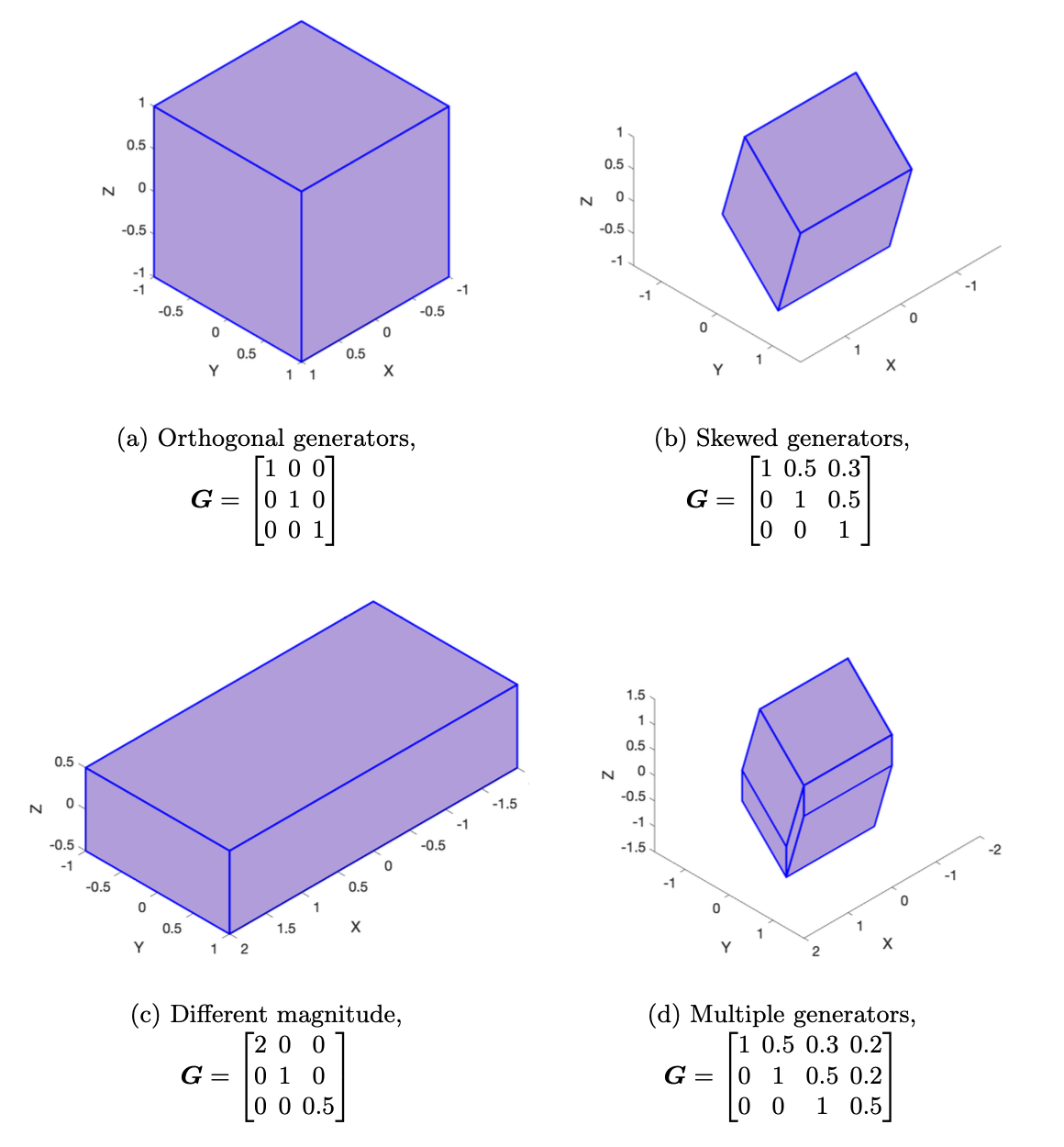
<p>A <strong>zonotope</strong> is a geometric object—essentially a center point plus a weighted sum of line segments. Mathematically, it’s expressed as:</p>

<div class="language-plaintext highlighter-rouge"><div class="highlight"><pre class="highlight"><code>Z = &lt;c, G&gt; = {c + Gξ | ||ξ||_∞ ≤ 1}
</code></pre></div></div>

<p>This structure makes zonotopes:</p>
<ul>
  <li>Closed under <strong>linear transformations</strong> and <strong>Minkowski addition</strong></li>
  <li>Compact and <strong>computationally efficient</strong></li>
  <li>Naturally suited for <strong>set-based estimation</strong> and control</li>
</ul>

<p><img src="/images/zono.png" alt="Zonotope Geometry" style="width: 800px;" /></p>

<p>Unlike ellipsoids or Gaussian-based filters like the Kalman Filter, zonotopes make <strong>no probabilistic assumptions</strong>. Instead, they simply assume noise is bounded—which is often a more realistic model in aerospace.</p>

<hr />

<h2 id="-why-not-kalman-filters">🔍 Why Not Kalman Filters?</h2>

<p>Kalman Filters (and even their nonlinear counterparts like EKF or UKF) assume that:</p>
<ul>
  <li>Uncertainties are Gaussian</li>
  <li>The system dynamics are either linear or well-approximated</li>
</ul>

<p>But in real-world aerospace scenarios:</p>
<ul>
  <li>Disturbances like solar pressure, drag, or model mismatch are <strong>non-Gaussian</strong></li>
  <li>Accurate covariance information may be <strong>unavailable</strong></li>
  <li>Safety demands <strong>guaranteed bounds</strong>, not statistical confidence</li>
</ul>

<p>Zonotope-based <strong>Set-Membership Filters (SMFs)</strong> overcome these limitations by estimating a <strong>set of all possible states</strong> consistent with measurements and dynamics.</p>

<hr />

<h2 id="-case-study-rendezvous-and-docking-in-elliptical-orbits">🚀 Case Study: Rendezvous and Docking in Elliptical Orbits</h2>

<p>In our paper, we applied zonotopic SMF to a spacecraft performing <strong>rendezvous and proximity operations</strong> using the <strong>Tschauner-Hempel</strong> equations to model relative dynamics in elliptical orbits.</p>

<p>We designed a filter that:</p>
<ol>
  <li>Propagates zonotopes forward using time-varying linear dynamics</li>
  <li>Updates the estimate with new measurements by minimizing the <strong>Frobenius norm</strong> of the generator matrix</li>
  <li>Feeds the <strong>center</strong> of the zonotope into a <strong>Model Predictive Controller</strong> to guide the spacecraft</li>
</ol>

<p><img src="/images/smf_mpc_block.pdf" alt="SMF and MPC Architecture" style="width: 800px;" /></p>

<p>Our MPC formulation used a standard quadratic cost function, incorporated real-world constraints like thrust limits, and relied on the <strong>set estimate</strong> rather than a point.</p>

<hr />

<h2 id="-results-at-a-glance">📊 Results at a Glance</h2>

<table>
  <thead>
    <tr>
      <th>Method</th>
      <th>Avg. Error (High Noise)</th>
      <th>Computation Time</th>
    </tr>
  </thead>
  <tbody>
    <tr>
      <td>Kalman Filter</td>
      <td>High</td>
      <td>Fast</td>
    </tr>
    <tr>
      <td>Ellipsoidal SMF</td>
      <td>Low</td>
      <td><strong>Slow</strong></td>
    </tr>
    <tr>
      <td><strong>Zonotopic SMF</strong></td>
      <td><strong>Medium-Low</strong></td>
      <td><strong>Fastest</strong></td>
    </tr>
  </tbody>
</table>

<p><strong>Conclusion</strong>: Zonotopic SMF strikes a sweet spot between <strong>robustness</strong> and <strong>real-time feasibility</strong>, especially when integrated with MPC.</p>

<hr />

<h2 id="️-toolbox-development">🛠️ Toolbox Development</h2>

<p>We are actively working on a <strong>Python-based reachability and estimation toolbox</strong>, incorporating:</p>
<ul>
  <li>Zonotopic operations</li>
  <li>Set-based filtering</li>
  <li>MPC integration</li>
  <li>Visualization utilities</li>
</ul>

<p>Stay tuned for an open-source release, and feel free to reach out if you’re interested in collaborations or early access.</p>

<hr />

<h2 id="️-final-thoughts">🛰️ Final Thoughts</h2>

<p>Zonotope-based filtering is more than an academic curiosity—it’s a scalable, real-world-ready solution for modern aerospace systems operating under bounded uncertainties. Whether it’s orbital maneuvers, cooperative multi-agent control, or autonomous rover navigation, <strong>set-theoretic methods provide rigorous guarantees where classical filters fall short</strong>.</p>

<p>If your mission can’t afford uncertainty, it’s time to think in <strong>sets</strong>, not points.</p>

<hr />

<p><em>Want to know more or see the math behind it? Read our full paper for technical details.</em></p>]]></content><author><name>Jinaykumar Patel</name><email>jnp7580@mavs.uta.edu</email></author><category term="cool posts" /><category term="category1" /><category term="category2" /><summary type="html"><![CDATA[Uncertainty isn’t just a nuisance in aerospace systems—it’s a fact of life. From uncooperative satellites to orbital debris, spacecraft navigating near each other must operate with incomplete, noisy, and sometimes deceptive data. For safety-critical missions like satellite rendezvous and docking, ensuring accurate and robust state estimation is paramount.]]></summary></entry><entry><title type="html">Advancing Safety in Space Missions Through Reachability Analysis</title><link href="https://jinaynitinpatel.github.io/posts/2024/05/blog-post-2/" rel="alternate" type="text/html" title="Advancing Safety in Space Missions Through Reachability Analysis" /><published>2024-05-11T00:00:00+00:00</published><updated>2024-05-11T00:00:00+00:00</updated><id>https://jinaynitinpatel.github.io/posts/2024/05/blog-post-2</id><content type="html" xml:base="https://jinaynitinpatel.github.io/posts/2024/05/blog-post-2/"><![CDATA[<p>In the complex and high-risk phases of space missions, particularly during the hypersonic re-entry of spacecraft into Earth’s atmosphere, ensuring safety and efficiency is paramount. This phase is fraught with challenges due to extreme conditions such as intense heat and dynamic pressures. To address these challenges, my research has focused on a sophisticated method known as reachability analysis, which has proven pivotal in enhancing the reliability of these missions.</p>

<h2 id="why-reachability-analysis-is-a-game-changer-for-space-missions">Why Reachability Analysis is a Game-Changer for Space Missions</h2>
<p>Reachability analysis allows us to predict all possible states a spacecraft might encounter as it re-enters the Earth’s atmosphere, providing invaluable data for ensuring a safe and efficient journey back to Earth. The benefits of employing this method are manifold:</p>

<ol>
  <li><strong>Enhanced Safety</strong>: This technique ensures that the spacecraft follows a safe trajectory, substantially minimizing the risks of catastrophic failures.</li>
  <li><strong>Increased Efficiency</strong>: By preemptively knowing all possible outcomes, engineers can design the most efficient re-entry paths.</li>
  <li><strong>Improved Reliability</strong>: The method provides a comprehensive map of potential scenarios, preparing mission planners to effectively handle various contingencies.</li>
</ol>

<h2 id="how-we-implement-reachability-analysis">How We Implement Reachability Analysis</h2>
<p>To perform these complex calculations, we use mathematical tools called zonotopes and constrained zonotopes. These tools help simplify the equations needed to accurately model the spacecraft’s trajectory.</p>

<h2 id="simulations-and-real-world-application">Simulations and Real-world Application</h2>
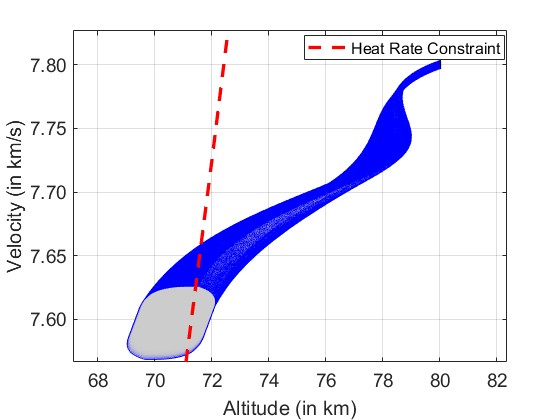
<p>Our simulations, which include both simplified models and more complex ones of hypersonic re-entry vehicles, demonstrate the effectiveness of our approach as demonstrated in <a href="https://doi.org/10.2514/1.G007549">our work</a>. These simulations are crucial for testing our predictions and refining the algorithms that underpin our models. Below is a figure illustrating the reachable sets for a hypersonic re-entry vehicle, showcasing how the heat rate constraint impacts the vehicle’s trajectory options:</p>

<p><img src="/images/heatcopy.jpeg" alt="Reachable Set for Hypersonic Re-Entry with Heat Rate Constraint" style="width: 800px;" /></p>

<p>In summary, reachability analysis is not just a theoretical construct but a practical tool that significantly boosts the safety and efficiency of hypersonic re-entry, paving the way for more reliable and ambitious space exploration missions. Through continuous research and development, we aim to extend these techniques to even more challenging missions, potentially including manned missions to other planets.</p>

<p>Stay tuned for more updates!</p>]]></content><author><name>Jinaykumar Patel</name><email>jnp7580@mavs.uta.edu</email></author><category term="cool posts" /><category term="category1" /><category term="category2" /><summary type="html"><![CDATA[In the complex and high-risk phases of space missions, particularly during the hypersonic re-entry of spacecraft into Earth’s atmosphere, ensuring safety and efficiency is paramount. This phase is fraught with challenges due to extreme conditions such as intense heat and dynamic pressures. To address these challenges, my research has focused on a sophisticated method known as reachability analysis, which has proven pivotal in enhancing the reliability of these missions.]]></summary></entry><entry><title type="html">Installing OpenMP on mac!</title><link href="https://jinaynitinpatel.github.io/posts/2020/12/blog-post-1/" rel="alternate" type="text/html" title="Installing OpenMP on mac!" /><published>2020-12-30T00:00:00+00:00</published><updated>2020-12-30T00:00:00+00:00</updated><id>https://jinaynitinpatel.github.io/posts/2020/12/blog-post-1</id><content type="html" xml:base="https://jinaynitinpatel.github.io/posts/2020/12/blog-post-1/"><![CDATA[<p>If you want to install OpenMP on mac, follow the steps below</p>
<ul>
  <li>Install homebrew for mac, if you don’t have already. Visit <a href="{https://brew.sh/}">brew</a> to install homebrew</li>
  <li>Installing gcc with brew</li>
</ul>
<figure class="highlight"><pre><code class="language-python" data-lang="python"> <span class="n">brew</span> <span class="n">install</span> <span class="n">gcc</span> </code></pre></figure>

<ul>
  <li>Find the location where gcc is being installed. Generally, it should be in /usr/local/bin. However, when calling a compiler your bash will look into /usr/bin by default. Hence, you need to add the new directory to your PATH. Export the path using following command.</li>
</ul>

<figure class="highlight"><pre><code class="language-ruby" data-lang="ruby"> <span class="n">export</span> <span class="no">PATH</span><span class="o">=</span><span class="sr">/usr/</span><span class="n">local</span><span class="o">/</span><span class="n">bin</span><span class="p">:</span><span class="vg">$PATH</span> </code></pre></figure>

<ul>
  <li>Now compile with OpenMP with following command</li>
</ul>

<figure class="highlight"><pre><code class="language-ruby" data-lang="ruby"> <span class="n">gcc</span><span class="o">-</span><span class="mi">10</span> <span class="o">-</span><span class="n">fopenmp</span> <span class="o">-</span><span class="n">o</span> <span class="n">prog_name</span> <span class="n">prog_name</span><span class="p">.</span><span class="nf">c</span> </code></pre></figure>

<p>Note:- gcc-10 is the current version that I installed. You may have installed gcc-8 or gcc-7 or maybe someother version in future release.</p>]]></content><author><name>Jinaykumar Patel</name><email>jnp7580@mavs.uta.edu</email></author><category term="cool posts" /><category term="category1" /><category term="category2" /><summary type="html"><![CDATA[If you want to install OpenMP on mac, follow the steps below Install homebrew for mac, if you don’t have already. Visit brew to install homebrew Installing gcc with brew brew install gcc Find the location where gcc is being installed. Generally, it should be in /usr/local/bin. However, when calling a compiler your bash will look into /usr/bin by default. Hence, you need to add the new directory to your PATH. Export the path using following command. export PATH=/usr/local/bin:$PATH Now compile with OpenMP with following command gcc-10 -fopenmp -o prog_name prog_name.c Note:- gcc-10 is the current version that I installed. You may have installed gcc-8 or gcc-7 or maybe someother version in future release.]]></summary></entry></feed>