
Zonotope-Based Filtering: A Scalable Approach to Uncertainty in Aerospace Systems
Published:
Uncertainty isn’t just a nuisance in aerospace systems—it’s a fact of life. From uncooperative satellites to orbital debris, spacecraft navigating near each other must operate with incomplete, noisy, and sometimes deceptive data. For safety-critical missions like satellite rendezvous and docking, ensuring accurate and robust state estimation is paramount.
In our recent research, we proposed a powerful alternative to classical stochastic filtering techniques: zonotope-based set-membership filtering, integrated within a Model Predictive Control (MPC) framework. This approach doesn’t just improve estimation—it ensures bounded safety, scalability, and computational efficiency in environments dominated by unknown-but-bounded (UBB) disturbances.
📦 What Are Zonotopes and Why Use Them?
A zonotope is a geometric object—essentially a center point plus a weighted sum of line segments. Mathematically, it’s expressed as:
Z = <c, G> = {c + Gξ | ||ξ||_∞ ≤ 1}
This structure makes zonotopes:
- Closed under linear transformations and Minkowski addition
- Compact and computationally efficient
- Naturally suited for set-based estimation and control
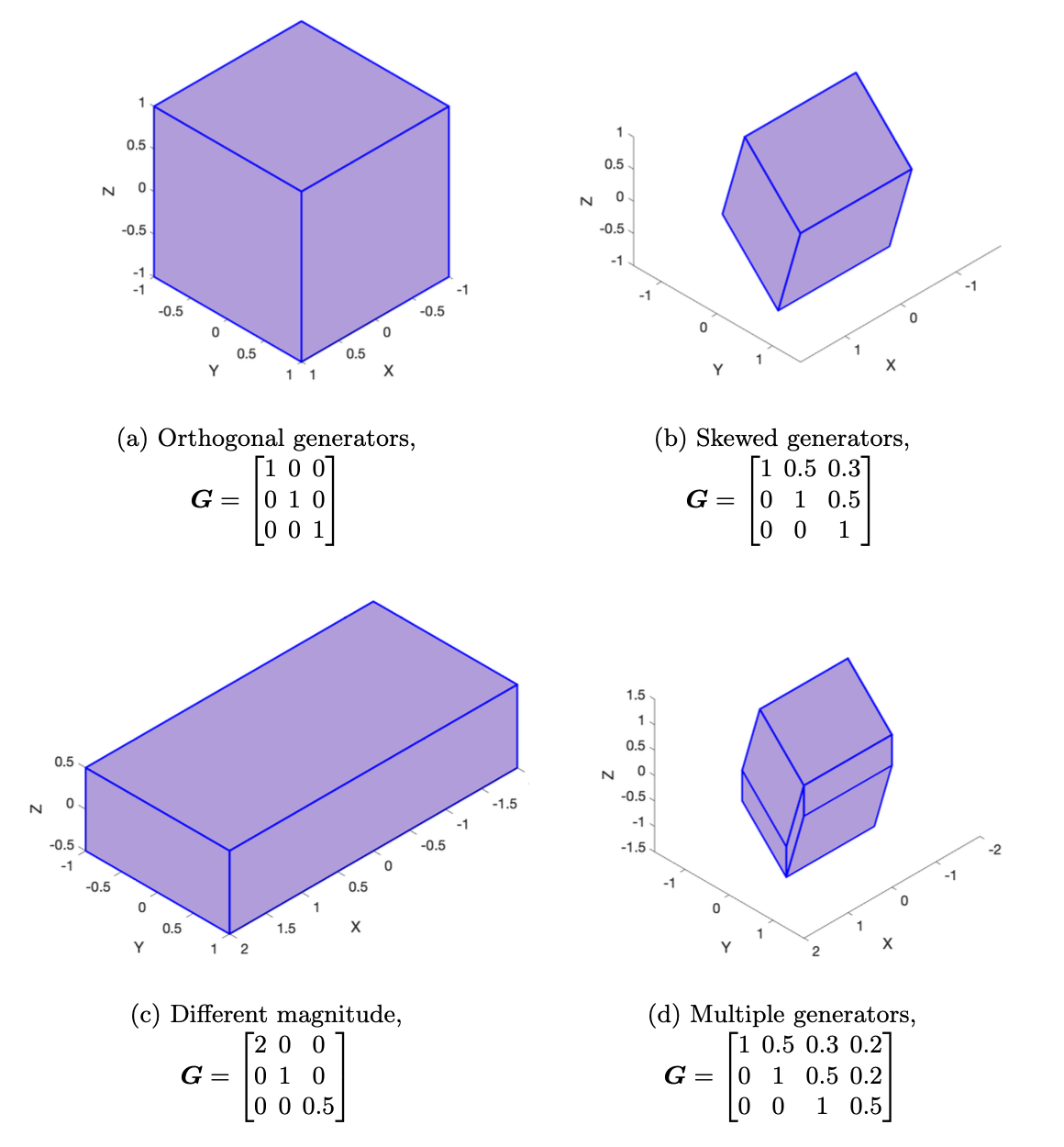
Unlike ellipsoids or Gaussian-based filters like the Kalman Filter, zonotopes make no probabilistic assumptions. Instead, they simply assume noise is bounded—which is often a more realistic model in aerospace.
🔍 Why Not Kalman Filters?
Kalman Filters (and even their nonlinear counterparts like EKF or UKF) assume that:
- Uncertainties are Gaussian
- The system dynamics are either linear or well-approximated
But in real-world aerospace scenarios:
- Disturbances like solar pressure, drag, or model mismatch are non-Gaussian
- Accurate covariance information may be unavailable
- Safety demands guaranteed bounds, not statistical confidence
Zonotope-based Set-Membership Filters (SMFs) overcome these limitations by estimating a set of all possible states consistent with measurements and dynamics.
🚀 Case Study: Rendezvous and Docking in Elliptical Orbits
In our paper, we applied zonotopic SMF to a spacecraft performing rendezvous and proximity operations using the Tschauner-Hempel equations to model relative dynamics in elliptical orbits.
We designed a filter that:
- Propagates zonotopes forward using time-varying linear dynamics
- Updates the estimate with new measurements by minimizing the Frobenius norm of the generator matrix
- Feeds the center of the zonotope into a Model Predictive Controller to guide the spacecraft

Our MPC formulation used a standard quadratic cost function, incorporated real-world constraints like thrust limits, and relied on the set estimate rather than a point.
📊 Results at a Glance
| Method | Avg. Error (High Noise) | Computation Time |
|---|---|---|
| Kalman Filter | High | Fast |
| Ellipsoidal SMF | Low | Slow |
| Zonotopic SMF | Medium-Low | Fastest |
Conclusion: Zonotopic SMF strikes a sweet spot between robustness and real-time feasibility, especially when integrated with MPC.
🛠️ Toolbox Development
We are actively working on a Python-based reachability and estimation toolbox, incorporating:
- Zonotopic operations
- Set-based filtering
- MPC integration
- Visualization utilities
Stay tuned for an open-source release, and feel free to reach out if you’re interested in collaborations or early access.
🛰️ Final Thoughts
Zonotope-based filtering is more than an academic curiosity—it’s a scalable, real-world-ready solution for modern aerospace systems operating under bounded uncertainties. Whether it’s orbital maneuvers, cooperative multi-agent control, or autonomous rover navigation, set-theoretic methods provide rigorous guarantees where classical filters fall short.
If your mission can’t afford uncertainty, it’s time to think in sets, not points.
Want to know more or see the math behind it? Read our full paper for technical details.